

Food Robot Task Reading: Piece Counts and Pick Weights
2026-11-05
Food Robot Task Reading: Piece Counts and Pick Weights
Food Robot Task descriptions need to say whether a requirement concerns discrete pieces or a target amount by weight. The phrase portioning can conceal that distinction in an offer. A system asked to place a counted item into a tray has a different documented target from a system asked to scoop a specified weight. This article reads two Chef Robotics explanations to clarify a fictional equipment enquiry. It reports no food-handling trial, production observation or assessment of hygienic suitability.
Identify the discrete-item requirement
Chef Robotics' January 8, 2026 piece-picking article distinguishes individually handled items from portions defined by weight or volume. It describes identifying and placing separate pieces, with examples such as individual sauce cups. Those examples identify the kind of task the supplier discusses; they do not demonstrate an unknown customer's product or establish an accepted delivery.
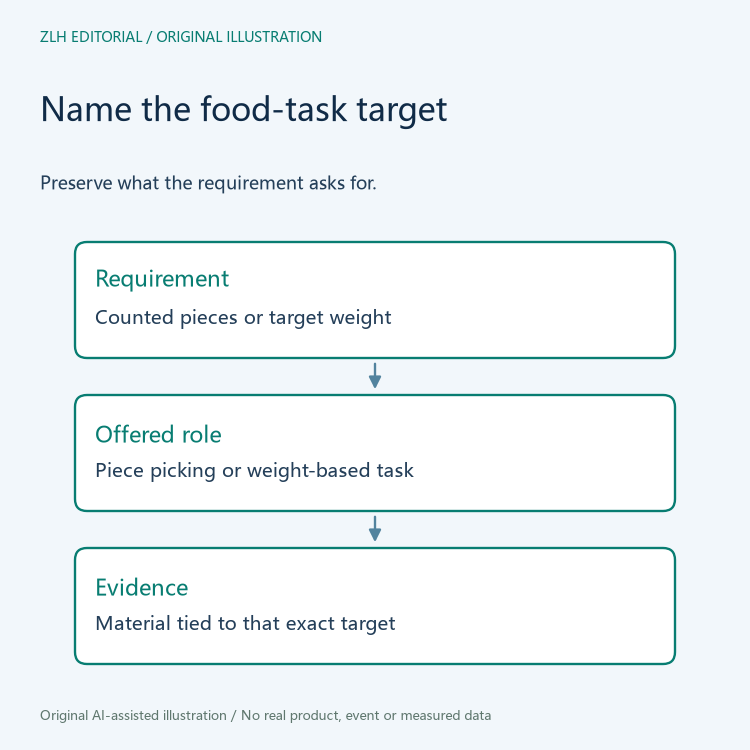
In a fictional proposal, a requirement might name a counted packaged item per tray. A review should preserve the item identity and the tray association. Replacing that wording with a general portion-weight field would lose the requested count. A weight total, without evidence about the individual contents, would leave the original discrete-item question unanswered.
Orientation can also be a separate part of the stated task. The supplier discusses placement orientation in its piece-picking explanation. A buyer can ask whether the offer includes an orientation requirement and how it is described. That question should remain distinct from whether the requested number of pieces was placed; neither observation automatically supplies the other.
Locate the target-weight requirement
The company's June 16, 2026 CLUTCH explanation describes a pick-depth estimator using ingredient-surface point-cloud information and target pick weight to produce a recommended depth. This is a manufacturer account of an estimation problem. Its weight target should retain that meaning when the article is summarized in an equipment appendix.
For another fictional offer, suppose an ingredient is described through a target weight. A record that says a utensil made one pick does not establish the picked amount. The count of pick actions and the ingredient weight are different subjects, even when both appear on the same production summary. This article sets no target, tolerance, utensil depth or checking procedure for a real line.
Do not substitute estimator output for the task result
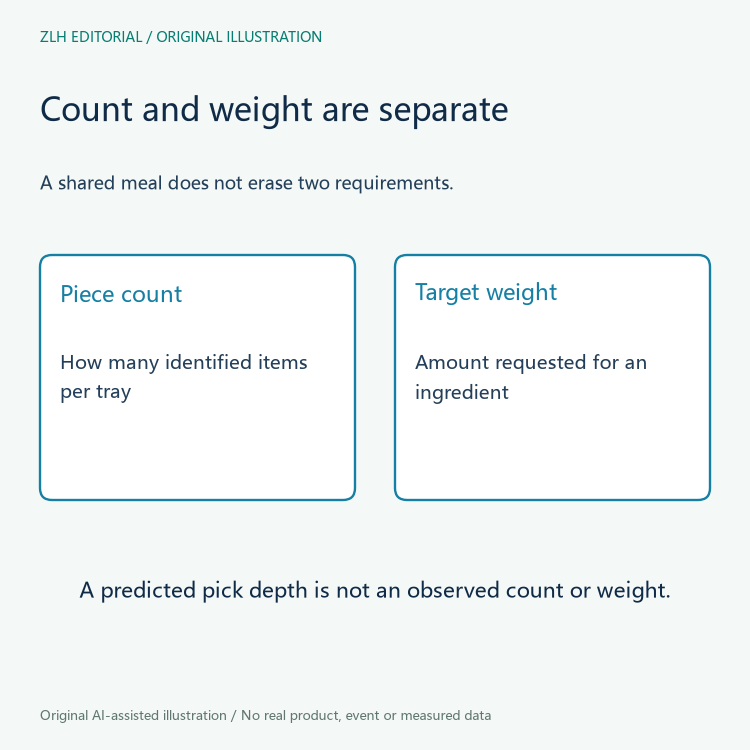
The CLUTCH description names a recommended pick depth as model output. That output is not itself an observed portion weight or a count of items placed in a tray. A procurement appendix should retain the connection between the documented input, prediction and separately supported task outcome. Renaming all three portion result would hide the part each record actually describes.
The article contains supplier evaluation results and comparisons. This discussion does not reproduce those figures as an acceptance threshold or claim that they establish performance for the fictional offer. An estimator explanation can clarify what a proposed system predicts while leaving the actual equipment, ingredient and receiving task to be documented by the parties.
Likewise, the piece-picking article contains wider commercial and capability statements. They remain attributed supplier descriptions. The fact that a named ingredient appears in a public article does not show that a particular offered configuration has handled the buyer's ingredient in the presented condition. The enquiry should stay attached to its own item, destination and requested result.
Keep mixed meal requirements separate
A fictional meal can include both a weight-defined ingredient and a counted item. That does not require one universal portion field. An equipment enquiry can preserve two requirements under the same meal identity, then ask which offered capability and evidence address each. Combining them into a single success label would make it difficult to tell which part remained unresolved.
If an appendix supplies a count record for one ingredient and a weight record for another, retain those associations. A later correction should say which ingredient and requirement changed. A change in documentation should not silently become an observed change in the robot's operation. No real meal specification or equipment configuration has been supplied for examination here.
Write a bounded equipment enquiry
A useful question names whether the target is a discrete count or an amount by weight, identifies the ingredient and destination, and asks what supplied material supports that particular requirement. Where a prediction is included, label it as a prediction. Where an observation is absent, preserve the gap rather than borrowing a result from another ingredient or a manufacturer example.
The references were read on November 5, 2026. Their publication dates locate the supplier explanations and do not announce a new deployment here. The original diagrams show documentation roles without real food, machinery or measured amounts. Related reading appears in the cooking robot equipment category and reference article category. A clear Food Robot Task retains the requested count or weight throughout the offer discussion, so evidence is requested for the task actually named.


