

Recipe Portal Practice: Trace Steps and Section Order
2026-11-05
Recipe Portal Practice: Trace Steps and Section Order
A recipe portal may present clear instructions to a reader while storing a different arrangement in its structured data. Before publishing a change, an editor can trace how the visible instructions correspond to individual steps and genuine groups of steps. This practice concerns the page's information structure. It does not turn a recipe into executable commands for a cooking robot, and it contains no food preparation settings or tested dishes.
Lay out the reader's sequence before opening the markup
Keep an identified copy of the proposed page and list its instruction blocks in reading order. Preserve any real section headings, but distinguish them from a decorative title, a promotional panel or a navigation link. The purpose of this first pass is to establish what the editor actually intends the reader to follow.
For an illustrative review, imagine a page whose author has separated its instructions into named groups. Record each group and the blocks it contains without inventing missing directions. A block that appears incomplete should remain an editorial question for the author. Reordering the instructions to make a database export look tidy could change the intended meaning before the review has even started.
Give each block a working location in the review note. That location is an editorial aid, not a public claim that the page already has an anchor or a particular schema identifier. If several displayed fragments belong to one instruction, record that observation rather than assuming every visual line must become a separate step.
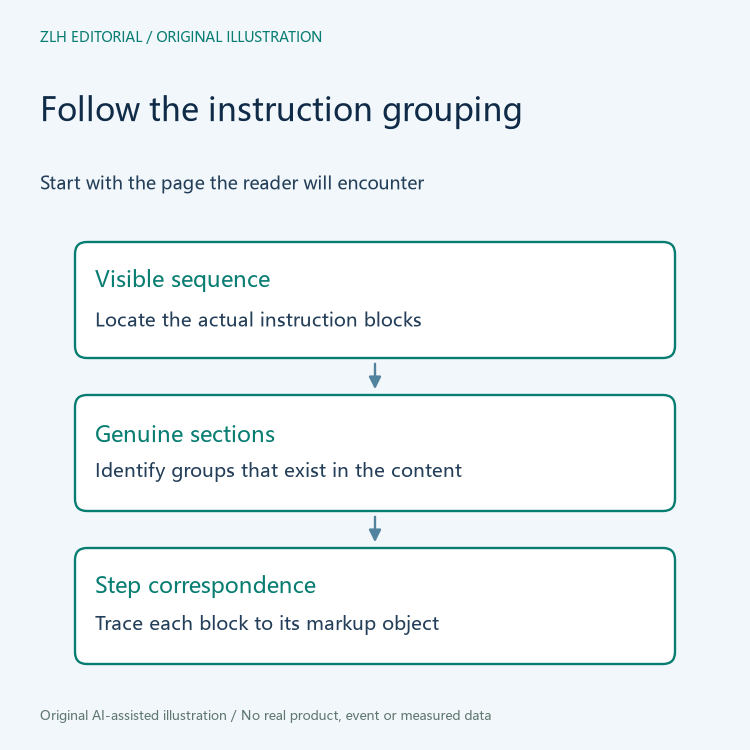
Classify instruction steps and genuine section groups
The Google Search Central recipe documentation recommends HowToStep for recipe instructions and explains that HowToSection can group steps when sections are needed. Its practical distinction helps the editor ask what each structured object represents. It does not justify adding sections that have no counterpart in the page's content.
Read the existing instruction objects alongside the working sequence. For each one, identify whether it describes an individual step or groups steps belonging to a real part of the instructions. Do not classify an object only by how long its text is. A short heading can label a group, while a longer paragraph may still describe one instruction block in the supplied material.
The Schema.org HowToSection definition describes a subgroup of steps within instructions. Use that definition to frame the grouping question, while keeping the portal's actual implementation and the relevant consumer's requirements in view. A vocabulary definition and a search feature's publishing guidance serve related but different purposes.
Where the existing markup does not provide enough information to identify a group, note the unresolved correspondence. This article supplies no ready-made recipe markup to paste across pages. Each page needs a mapping that reflects its own instructions rather than a shared pattern of invented section names.
Trace each group inward and return to the visible page
Within a genuine section, follow its contained steps in the order presented by the supplied representation. Compare that sequence with the retained page copy. Keep a note of the section path as well as the individual step location, because a familiar step label can otherwise appear to match an instruction in the wrong group.
Consider a hypothetical editorial difference in which one instruction remains visible on the page but cannot be located in the associated group of structured steps. The appropriate observation is a missing correspondence in the materials reviewed. It is not evidence that a robot skipped an action, that a meal was prepared incorrectly or that a search engine processed the page in a particular way.
Check the reverse direction as well: an instruction object should have an identifiable counterpart in the material the publisher intends to present. If an object contains unrelated promotional wording, retain that wording as an editing issue instead of quietly treating it as a cooking direction. Record proposed content changes separately from the original evidence.
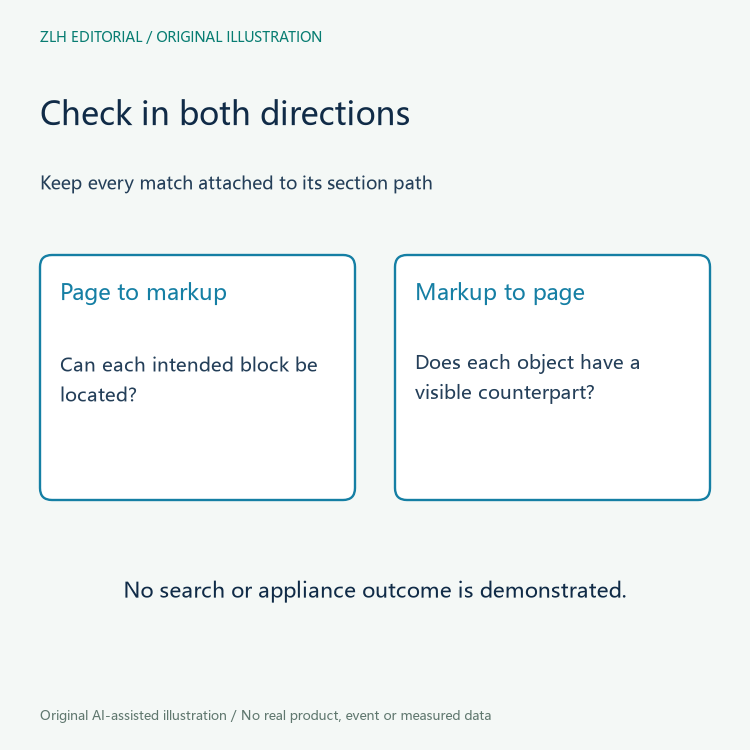
Hand over a correspondence note with bounded conclusions
The final note should let another editor move between the page location, any section group and the corresponding step object. Identify unmatched blocks, uncertain grouping and disagreements in order. When the author resolves one of those questions, retain the revision context so the next reviewer can understand why the mapping changed.
This kind of check can support a publishing review, but it cannot establish that a recipe is safe, nutritionally accurate or compatible with a cooking appliance. It also does not guarantee a rich result, search ranking or indexing outcome. Those are separate questions requiring evidence beyond the presence of structured instruction objects.
The original diagrams show editorial relationships, not food, measured cooking results or robot motions. The cooking technology reading collection discusses other information-handling questions, while the article directory lists the broader coverage. A useful review ends with an understandable map of the instructions and a clear account of anything still unresolved.


