

Food Robot Acceptance: Define the Sticky Ingredient Task
2026-11-04
Food Robot Acceptance: Define the Sticky Ingredient Task
A sticky ingredient task is not fully described by the phrase the robot can handle food. A procurement discussion needs to identify what happens between collecting an ingredient and leaving it in the intended location. Material remaining on a utensil can matter even when pickup appears successful. Chef Robotics has published a useful account of this release problem, which can help a buyer formulate an acceptance question. The discussion below uses a hypothetical delivery and reports no robot trial or food-safety validation.
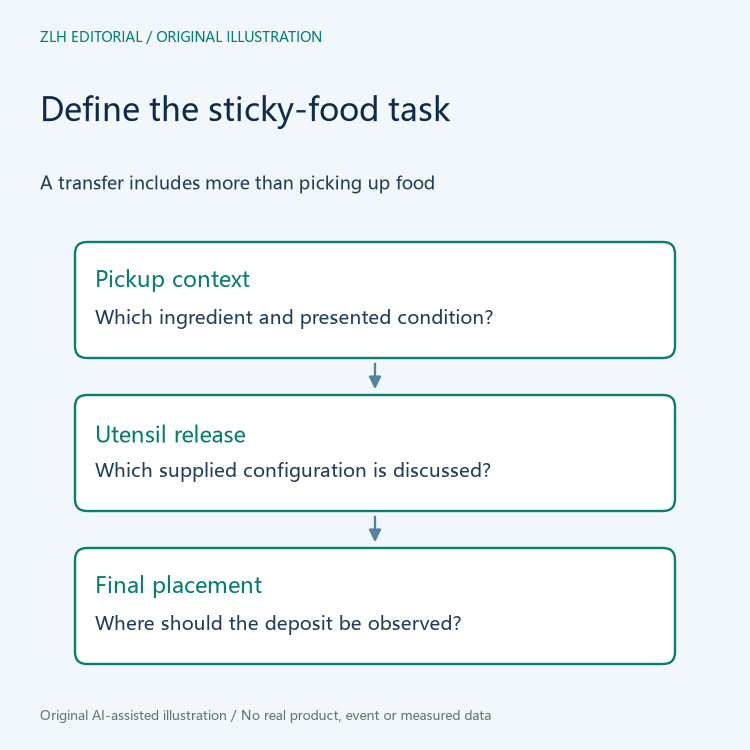
Define the beginning and end of the assembly task
Ask the supplier to name the ingredient, its presented condition, the intended portion and the destination. A robot might be expected to transfer food into a tray, distribute it across a surface or deposit it into a particular compartment. Those are different task descriptions. The acceptance record should make the intended endpoint recognizable without requiring a reviewer to infer it from a product video.
For a fictional example, imagine a prepared-meal team discussing a sticky filling placed into a divided tray. The buyer needs an account of pickup, release from the utensil and placement in the nominated area. This is not a test result or a proposed operating recipe. It is a way to identify the observations the parties would need before treating the promised task as demonstrated.
Read the supplier's release explanation as an attributed claim
In its August 2025 article on serving very sticky foods, Chef Robotics describes difficulty releasing sticky ingredients from utensils. The article distinguishes several approaches in its own system and describes an additional vibrating mechanism for ingredients that require a different release approach. These are the company's published explanations, not mechanisms or performance independently tested by this publication.
The useful procurement implication is to ask which supplied configuration supports the particular ingredient task. Do not infer that every food on a menu requires the same utensil or release method. Equally, do not turn the vendor's list of example ingredients into proof that an untested recipe with a similar name will behave identically. Ingredient identity and actual presentation conditions remain part of the agreed review.
This article intentionally supplies no motion, air or force settings. A public description can explain why a release stage deserves attention without becoming an instruction to reproduce that mechanism on another robot. Any demonstration belongs with the responsible supplier and the defined receiving environment.
Retain the surrounding configuration in the acceptance pack
The company's AI-enabled food assembly system page describes configuring its system around ingredients, portions, trays, placement requirements and conveyors. For the buyer, these categories provide a useful checklist of context to request. The page is a supplier product description and contains broader commercial claims; it does not establish the outcome of the fictional task discussed here.
Ask the supplier to identify which configuration was offered, which utensil belongs to the demonstration and how the destination arrangement is represented. If the package includes several utensils or recipe variants, retain the association for each reviewed case. A demonstration using a different destination or a different ingredient condition should be described as a different case, not silently substituted for the requested one.
The handover should also distinguish what was supplied as documentation from what was observed. A statement that a system can be configured does not show that the offered configuration has been completed. If the buyer has only received a proposal, record the proposed scope and the evidence still to be obtained. That is a useful procurement finding without an invented success story.
Observe release and placement as separate questions
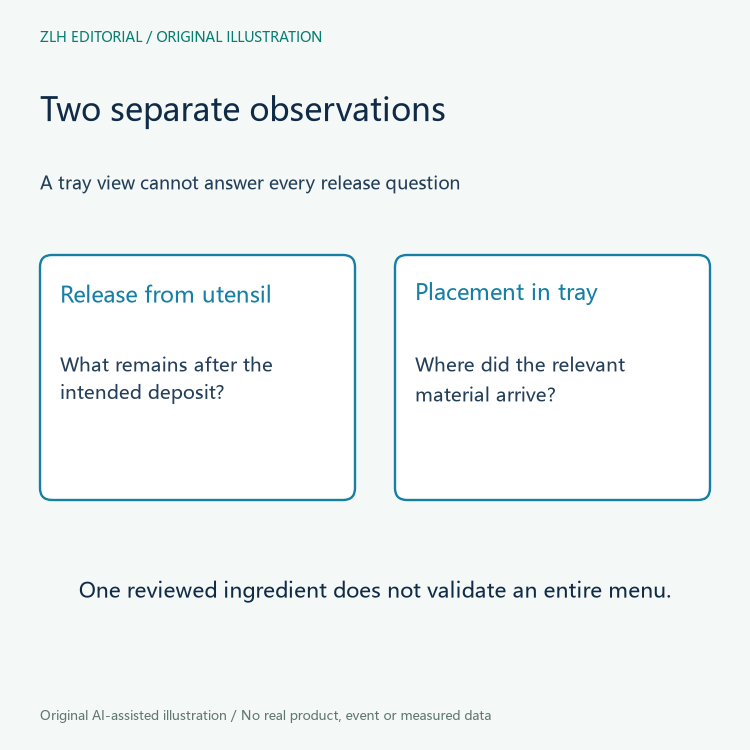
A defined demonstration can ask whether relevant material remains on the utensil after the intended release and where the deposited material is located. The parties should agree how those observations will be described and which requirements apply. This article sets no universal tolerance, weight target or number of repetitions. Those choices need the actual task, agreement and appropriate expertise.
A deposit may be present in a tray while still leaving a different release question unanswered. Conversely, a clean-looking utensil does not by itself show that the material reached the intended compartment. Keep the two observations separate before interpreting the overall outcome. A selected video frame can help locate a question but should not replace the retained observation record needed for acceptance.
Close only the task that was actually reviewed
An acceptance note should name the ingredient case, configuration, receiving arrangement and evidence reviewed. If another menu item remains unexamined, list it separately. Do not convert one demonstrated transfer into a claim about the entire menu, production throughput or hygienic suitability. A food robot can involve several independent procurement and validation questions, each needing evidence appropriate to its subject.
The original illustrations show the task boundary without depicting real food handling or measured deposits. Continue through the cooking robot procurement collection and the article directory for related reading. Defining pickup, release and destination makes the supplier conversation more concrete while preserving the limits of what the published sources and any later demonstration can support.


