

Cooking Robot Portals: Read the Inactivity Time Limit
2026-11-04
Cooking Robot Portals: Read the Inactivity Time Limit
A cooking robot procurement portal may ask a restaurant team to describe its menu, staffing and proposed installation. Completing that enquiry can require a pause to consult another colleague. If the page ends the session during that pause, a buyer needs to understand both the time rule and what happens to the entered information. Reading an inactivity time limit carefully makes the supplier discussion more specific. This article concerns an administrative web task, not the control of cooking equipment or a food-safety assessment.
Locate the time rule before reviewing its wording
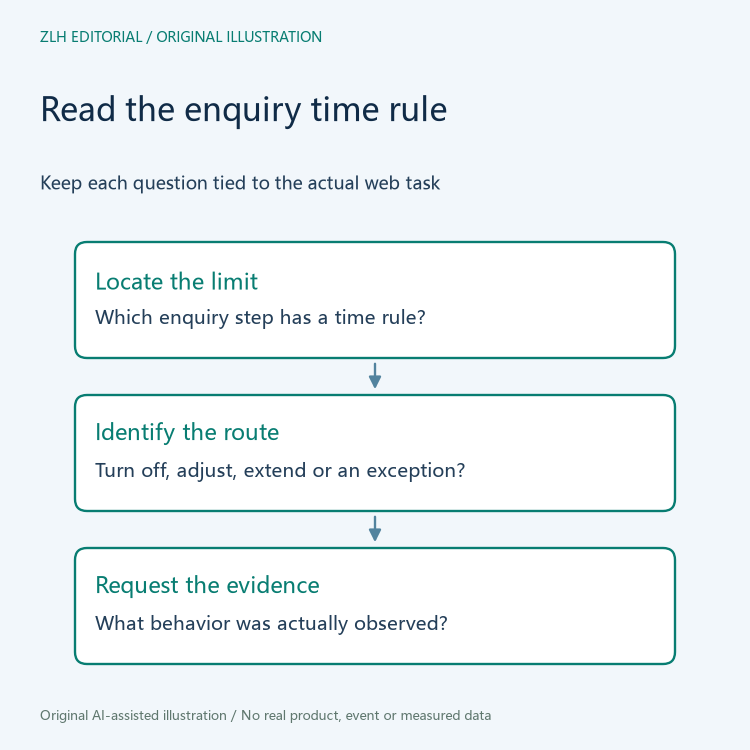
First identify the task and the point at which the rule applies. A general account notice, an enquiry form and a temporary notification can describe different behavior. Do not assume that a clock symbol refers to every page in the portal. Ask which content sets the limit, what event starts or resets it, and which task would be interrupted when time expires. The answers should refer to the delivered interface rather than an unrelated supplier presentation.
For a hypothetical enquiry, imagine that a restaurant manager leaves a draft installation question open while checking a floor plan. That scenario creates a useful review question: what does the page tell the manager before the pause, and what information will remain afterwards? It does not establish that any actual supplier loses data. Keep the scenario visibly hypothetical until a permitted demonstration produces a record.
Distinguish adjustment from advance information
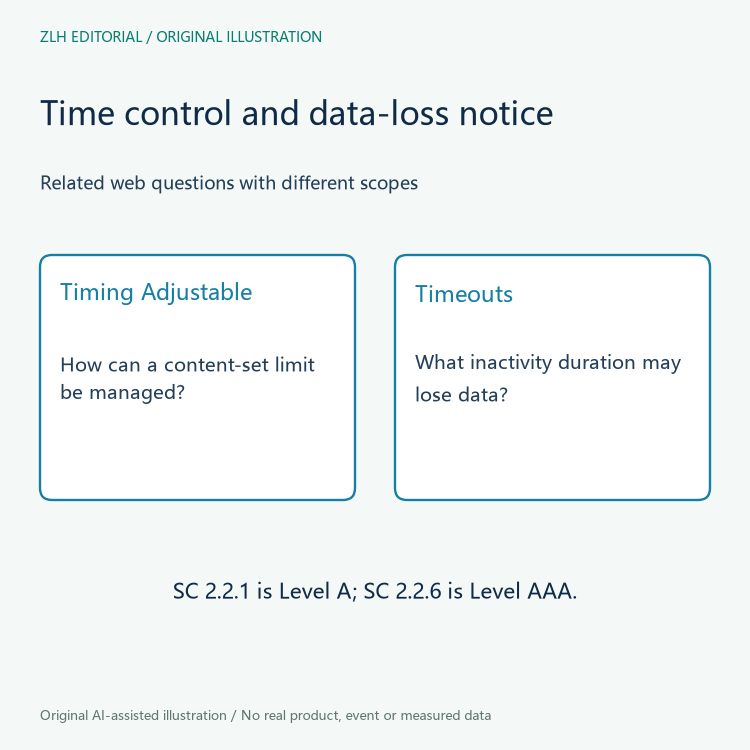
The W3C explanation of Timing Adjustable, Success Criterion 2.2.1, identifies a Level A criterion concerning time limits set by content. It sets out routes involving turning a limit off, adjusting it or extending it, with specified conditions and exceptions. The extension route includes a warning and a simple action, with at least twenty seconds to respond and the ability to extend at least ten times.
That is different from merely displaying a sentence that the session will end soon. A warning can describe a limit without providing the adjustment or extension behavior relevant to the criterion. Conversely, a supplier may describe a different applicable route rather than an extension button. The buyer should ask which route is claimed and what evidence supports that particular account, instead of demanding one interface pattern for every situation.
Read the inactivity and data-loss question separately
The W3C explanation of Timeouts, Success Criterion 2.2.6, identifies a Level AAA criterion. It focuses on warning users of the duration of inactivity that could cause data loss, unless data is preserved for more than twenty hours without user action. The explanation says that this notice belongs at the beginning of the related task or process, rather than at every step.
The different level and subject should remain visible in a procurement note. A statement about this inactivity notice is not interchangeable with a statement about all Level A timing requirements. Nor does one reviewed notice establish that the whole portal conforms to WCAG. The two Understanding pages help explain their associated criteria; a formal evaluation needs its defined scope and applicable requirements.
Ask what the supplier means by preserving the draft. A visible form, a saved server-side draft and a recoverable submission may be different promises. This is an editorial distinction for gathering an answer, not a claim about the portal's storage implementation. Request the scope of preserved information and any relevant conditions. Do not use real staff or customer information merely to make a demonstration seem realistic.
Keep exceptions attached to the specific activity
The Timing Adjustable explanation includes real-time and essential exceptions and a limit longer than twenty hours. A buyer should not remove those conditions from a summary, but should also avoid accepting the word security as a complete explanation of every time rule. The same page explains that content-set limits used for security can still be within the criterion's scope, while some particular security mechanisms can be essential.
The appropriate follow-up is therefore about the actual activity. What functionality would change if the limit were extended, and which documented exception is the supplier invoking? This article does not decide that question for an unknown portal. It also does not recommend retaining enquiry data for a particular duration. The Timeouts explanation explicitly recognizes privacy considerations around preservation, which require their own project-specific assessment.
Turn the reading into a bounded supplier question
Prepare a short request that names the enquiry task, quotes the portal's actual notice if available, and asks about the relevant timing route and information state. Arrange any demonstration in an authorized test setting using invented enquiry content. Record the starting page, the behavior observed and the information available after the interruption. If no demonstration has taken place, label the behavior as unverified rather than writing an assumed result.
A useful procurement conclusion can say that the supplier explained a time rule and provided an applicable notice. It should say separately whether adjustment, extension or data recovery was actually checked. Neither a readable notice nor a successful web task proves that a cooking robot meets operational or hygiene requirements. Those questions need separate acceptance evidence associated with the machine and its intended use.
The accompanying illustrations map the two web questions without fabricating a portal screenshot or timing measurement. Continue through the cooking robot procurement collection and the article directory for related reading. Preserving the distinction between time control and advance information helps a restaurant team request an answer that can be reviewed, while leaving unobserved behavior open.


