

IFR Service-Robot Paper: Read Hospitality at Task Level
2026-11-02
IFR Service-Robot Paper: Read Hospitality at Task Level
A restaurant can contain many different activities, from moving items through a dining area to preparing ingredients in a kitchen. A news item about robotics in hospitality does not identify which of those activities a particular machine can perform. IFR’s September 2026 announcement of a service-robot position paper offers an opportunity to make that distinction clear. This article reads the public announcement on November 2, 2026, using an imaginary restaurant planning conversation. No restaurant, robot, or food-handling process was inspected.
What the public announcement actually covers
The IFR announcement dated September 24, 2026 describes a position paper spanning several sectors, including hospitality. It discusses workforce pressures and says different robot forms can suit different applications. Those are broad observations about service robotics, rather than a specification for a kitchen machine.
The IFR paper directory lists the service-robot paper as released in September 2026 and states that downloading papers requires registration. This article relies on the public announcement and directory. It does not imply that the full registered-access paper was downloaded or that a hidden passage supports a particular cooking claim.
Start with the activity the restaurant means
In the imaginary discussion, one colleague says the restaurant should investigate a “hospitality robot.” Another hears that as a proposal to automate cooking. Before comparing products, the participants need to establish what work they are discussing. Carrying a tray and changing the physical state of ingredients are different tasks.
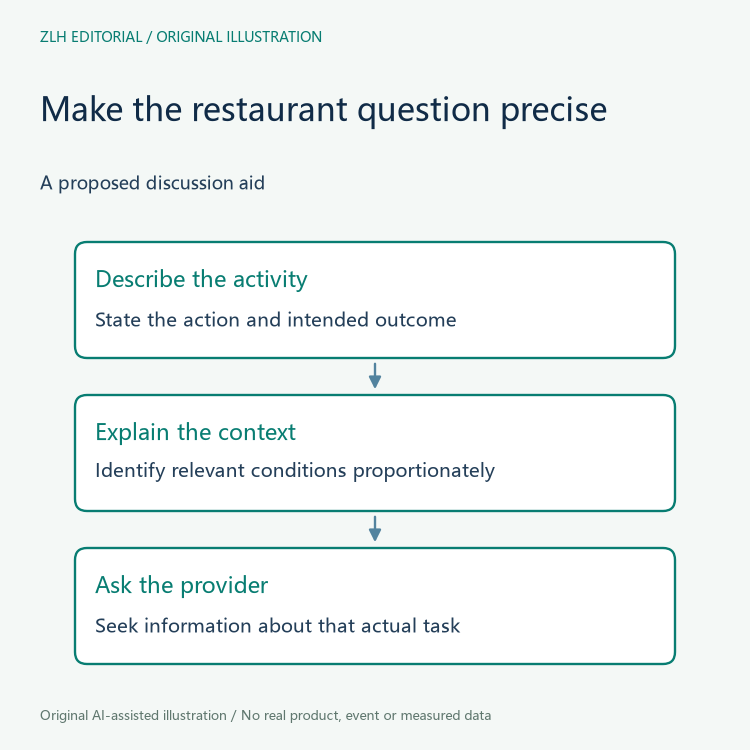
The team can describe an intended activity in ordinary language: what enters the activity, what action is wanted, and what outcome would matter to the restaurant. This is a way of clarifying the conversation, not a technical operating procedure. It supplies no loading instructions or recipe parameters.
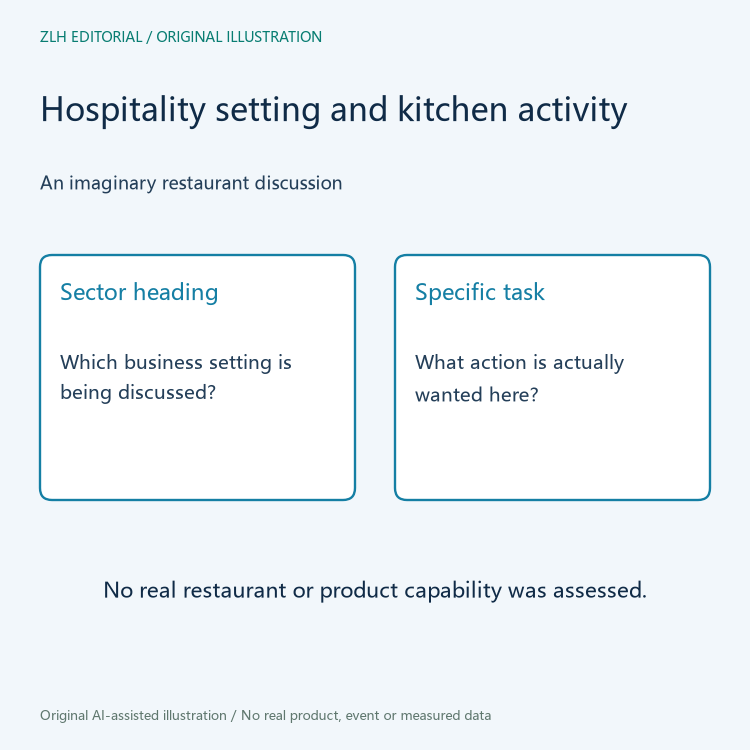
A sector is a place to search, not a capability list
A hospitality heading can help an editor organize stories about related businesses. It does not establish that every robot in that heading can undertake every activity in those businesses. The same setting may contain equipment with quite different purposes.
For the fictional restaurant, a useful product inquiry would name the intended activity before asking a provider about relevant capabilities. The provider’s actual description should answer that question. The restaurant should not fill the answer from a sector-wide news summary or assume that a nearby application is equivalent.
This distinction also improves a short internal briefing. Instead of writing that a machine “does hospitality,” the author can explain which activity the team is considering and which information remains unconfirmed. Readers then know where the discussion has reached without mistaking a broad label for a completed evaluation.
Keep restaurant conditions in the question
An activity takes place in a particular arrangement of people, space, and equipment. A description that makes sense in one arrangement may leave important questions unanswered in another. The fictional team therefore needs to explain its own intended context when seeking further information.
That does not mean publishing staff details or an unnecessary floor plan. A proportionate question can describe the relevant task and context without exposing private operational material. The article offers no actual site layout, staffing model, throughput figure, or claim that automation would reduce employment.
Do not attach a food claim to unrelated sector news
A broad service-robot announcement is not evidence about a specific machine’s contact with food, cleaning outcome, or suitability for an ingredient-handling activity. If those questions arise in a real project, they need information appropriate to that equipment and use.
The imaginary conversation deliberately stops short of such a conclusion. It does not provide a safety approval, sanitation method, or purchasing recommendation. A clearly stated unresolved question is more useful than an attractive briefing that quietly assumes the central issue has already been answered.
Turn the news into a clearer next conversation
The practical value of the September announcement is that it invites readers to consider service robotics across varied applications. A restaurant reader can take that broad context and formulate a narrower question about an actual task. The narrowing is editorial work; it should not be attributed to IFR as a mandated evaluation sequence.
A proposed meeting note could record the activity being discussed, the reason it matters, and the question a provider still needs to answer. Such a note leaves the decision open. It makes the next conversation more specific without inventing product capabilities or a completed deployment.
Use the same activity description in the inquiry so that a reply addresses the original restaurant question.
See our cooking-robot application discussions and the article directory for further reading. The two original conceptual illustrations contain no real restaurant, product, measured workload, or food-processing result.


