

Vertical Form Fill Seal: From Flat Film to Closed Bags
2026-11-10
Vertical Form Fill Seal: From Flat Film to Closed Bags
Vertical Form Fill Seal equipment turns a continuous web of packaging film into a sequence of filled bags. The film travels over a forming shoulder and wraps around the outside of a hollow tube. Product can travel down the inside of that tube. The bag is formed through that relationship between the two paths and through seals that run in different directions.
The forming shoulder brings the two film edges together
Viking Masek describes the starting material as a flat web unwound from a roll. As the film passes over the shaped shoulder, the shoulder guides its edges around the forming tube. One face of the film now faces the tube and the other faces away. At the seam location, the two longitudinal edges come together.
Figure one uses two arrows to distinguish the material paths. The film wraps around the tube's outside. The fill travels inside the hollow tube and emerges below it. The metal forming tube is a part of the machine, while the moving tube made of film becomes part of the package.

The longitudinal seam closes the sides of the film tube
The manufacturer's operating overview describes a vertical sealing element where the film edges meet. Joining the two edges closes the film around its circumference while it still extends along the machine's vertical axis. That joint becomes a seam running along the length of the finished bag.
Viking Masek distinguishes two ways that the edges can meet. In a lap seam, one edge overlaps the other in a relatively flat arrangement. In a fin seam, the inside faces of the two edges meet and form a projection from the tube. These are distinct cross-sections of a lengthwise seam, even when the final bags have similar outlines in a front view.
Cross seals define the ends of adjacent bags
A tube of film with its longitudinal seam closed still has open ends. The cross-seal jaws press the material together across the tube to form end seams. In the machine arrangement described by Viking Masek, the jaws can create the top seam of one bag and the bottom seam of the following bag in the same operation.
Figure two treats the packaging film as a continuous vertical object. The shaded bands on opposite sides of the separation mark belong to adjacent bags. The upper band forms the bottom of the higher, following bag, and the lower band forms the top of the bag beneath it. A cut between them separates the finished bag while each retains its own seam.
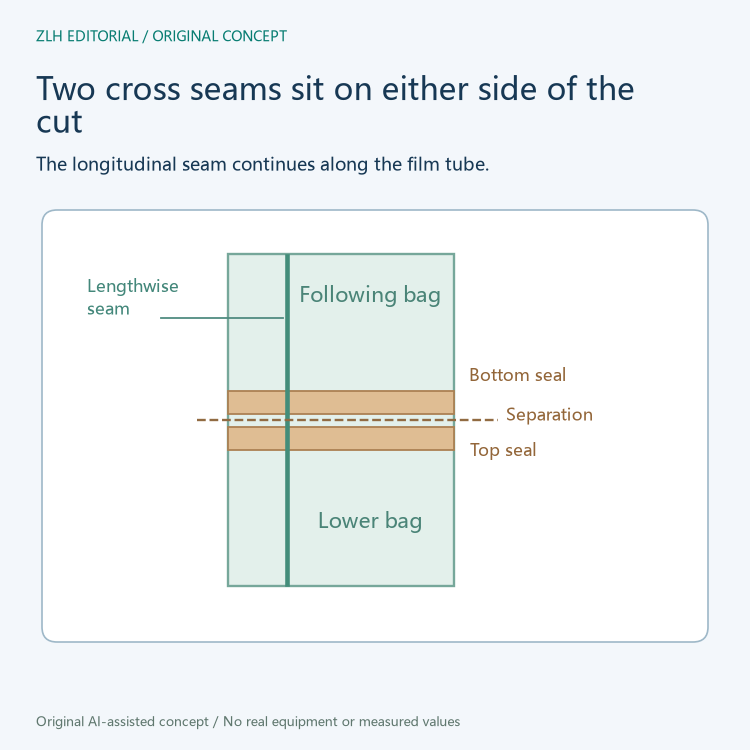
The same two jaws therefore participate in producing both ends of any given bag at different points in its travel. One closure gives the bag a bottom seam while it is the following bag. A later closure gives it a top seam after it has advanced. The gap between those two seam locations belongs to one package.
Product travels through the center of the forming assembly
The manufacturer's glossary describes product passing down the hollow forming tube into a bag after its lower seam has been formed. The filler provides the measured portion. The forming shoulder and sealing elements provide the film shape and boundaries that contain it. These functions can appear next to one another without belonging to the same part.
For example, a line drawing can place a filler above the forming assembly, with a web of film arriving from one side. The filler deals with what enters the package. The film web forms the outside of the package and continues toward the sealing and discharge region. Showing both routes makes the layout readable without using the finished bag as the only visual reference.
Use seam orientation to identify the function on a drawing
The forming tube assembly depends on the required bag dimensions and style in the manufacturer's glossary. Two packages that use different bag dimensions may have different forming shoulders and tubes. A drawing of a finished bag can identify the longitudinal seam, the top and bottom cross seams and their relation to the forming assembly. Those are separate attributes from the fill amount.
A packaging line record can preserve the machine example, the film path, the product path and the location of each seam. The two cross seams describe the ends, while the longitudinal seam describes how the original flat web was closed around the package. Those positions remain useful when comparing two machine layouts.
See Viking Masek's vertical bagging overview for the forming and sealing relationships and the Viking Masek packaging glossary for the forming assembly and seal elements. Browse food production equipment references and the technical article library.


