
High-Pressure Homogenization: Where Milk Droplets Break
2026-11-10
High-Pressure Homogenization: Where Milk Droplets Break
High-Pressure Homogenization changes the size of fat globules suspended in milk. It sends a pressurized emulsion through a narrow valve gap and forms a fast jet on the outlet side. In the account given by Tetra Pak and SPX FLOW, turbulence in that jet supplies the forces that break the globules into smaller droplets. The pump, valve gap and outlet chamber each contribute a different part of the process.
The pump supplies energy and the valve concentrates the flow
The piston pump delivers milk to the homogenizing device. In the Tetra Pak handbook, the restriction between the valve member and seat creates resistance to that flow. Pressure builds on the upstream side. As milk moves through the narrow passage, it accelerates and loses static pressure. A short distance downstream, it emerges as a high-speed stream in a larger outlet chamber.
The gap can be much larger than the droplets leaving the homogenizer. Its purpose is to accelerate the liquid through a small flow area. In a sieve, a solid piece is held back when it is too large to pass an opening. Here the dispersed fat travels through with the surrounding milk. Most of the particle-size change is explained by what happens to the fast stream as it exits.

Turbulent motion breaks globules downstream of the gap
Tetra Pak describes a turbulent jet that slows and transfers energy to swirling motions of the surrounding liquid. These motions exert varying forces on different parts of a droplet. They can stretch the globule, and a sufficiently deformed globule can separate into smaller ones. The handbook limits this explanation to dispersions such as milk, in which small droplets of fat are carried in a relatively low-viscosity liquid.
Breaking a globule creates fresh surface. If a fixed volume of fat is split into many small drops, the drops collectively have more surface area than the original large one. The handbook explains that the original globule membrane cannot cover that whole area. Proteins from the surrounding liquid, mainly casein in the cited description, become part of the new interface. The change in particle size therefore also changes the area over which the two phases interact.
The second stage changes conditions at the first stage
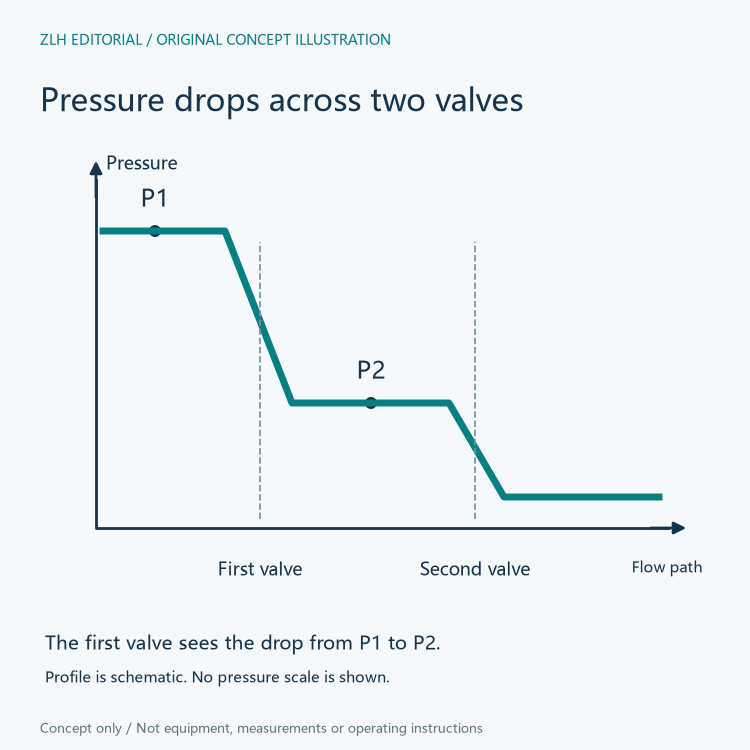
A two-stage system has two restrictions in series. P1 is the pressure upstream of the first valve, and P2 is the pressure between the valves. The first valve sees a pressure drop of P1 minus P2. SPX FLOW emphasizes that backpressure can include a contribution from equipment farther downstream. A pressure at the inlet of the assembly, considered by itself, leaves the interstage condition unknown.
SPX FLOW describes a tradeoff. Interstage backpressure can suppress the formation of vapor cavities and support the turbulent jet, but raising it at a fixed P1 also leaves a smaller pressure drop for the first valve. The bulletin illustrates this using particular test configurations. Tetra Pak also assigns the second stage a role in dispersing clusters that form after the main breakup. A cluster of several newly formed droplets and one large original droplet are two different structures.
Particle size and creaming describe different observations
Smaller fat droplets tend to rise more slowly through the continuous liquid phase under comparable conditions. Slower rise helps delay formation of a visible cream layer. Particle size describes the dispersed fat at the scale of individual globules. Creaming describes how the overall distribution of fat changes over time, so its interpretation also depends on the conditions of the sample.
The Tetra Pak handbook separates direct assessment of creaming from analysis of the particle-size distribution by laser diffraction. Its discussion of the latter describes preparing the sample to focus on fat globule breakup instead of protein associations. A reported average size is a summary of a distribution, and the handbook and SPX FLOW bulletin give different examples of how a distribution can be summarized. Two measurements are easier to compare when the method and the type of average accompany the number.
The distribution also reveals details that an average can hide. Two curves with a similar average can have different proportions of fat in their largest globules. A volume-based distribution gives those large globules more influence than a simple count of droplets would. This is one reason the size curve and the observation of creaming are complementary when studying the effect of the valve.
When reading a dairy equipment diagram, follow the pressure locations from the pump to the first valve and the space between stages. Then follow the fat globules from the original emulsion into the outlet jet and past any cluster-breaking stage. That reading connects the equipment drawing to the physical change it was built to make. Further references are available in the food machinery collection and the technical article archive.
Primary sources Tetra Pak Dairy Processing Handbook, Homogenizers and SPX FLOW technical bulletin on the second-stage valve.