

Planetary and Spiral Mixers: Bowl and Agitator Motion
2026-11-09
Planetary and Spiral Mixers: Bowl and Agitator Motion
Planetary and spiral mixers bring the mixing tool and ingredients together in different ways. A planetary mixer keeps the bowl still during mixing and moves the agitator around it. A spiral mixer of the type documented by Hobart turns the bowl while the spiral hook spins. A drawing can identify which parts move and explain how ingredients repeatedly pass through the working area.
The planetary agitator moves around the bowl
Hobart describes a commercial planetary mixer as having a stationary bowl. The agitator travels around the bowl as the mixing mechanism operates. Its A120 and A200 service manual distinguishes motion of the planetary mechanism from turning of the agitator, which has a pinion on its shaft. The tool spins about its own spindle, while the spindle travels around the center of the vessel.
One way to read a top view is to mark the center of the bowl, then mark the location of the agitator spindle. The bowl center is fixed relative to the machine. The agitator spindle changes location relative to that center. A separate arrow on the agitator can indicate its spin. Two arrows are useful because the two motions would otherwise look like a single turn of the bowl.

The spiral mixer moves the bowl through the working area
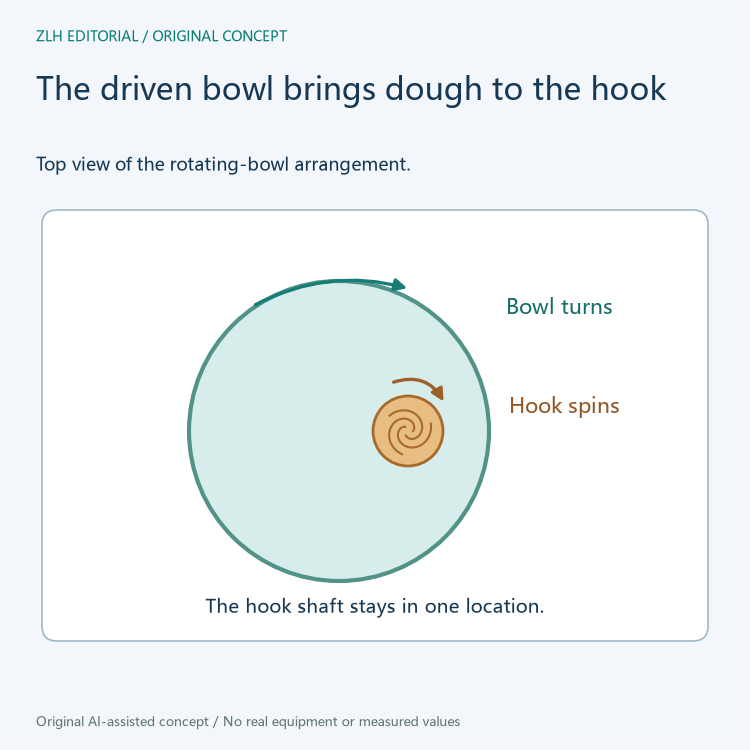
Hobart's spiral comparison describes a rotating dough hook and a driven bowl. The hook turns about its own shaft, and the bowl turns beneath it. Material in the bowl is brought repeatedly through the part of the vessel where the hook works. The hook's movement and the bowl's movement both contribute to that repeated encounter.
In a top view of this type of spiral machine, the bowl rim can be shown turning around its center and the hook spinning at its own working location. A mark on the bowl would move relative to the mixer frame. That is a different drawing from one where the rim stays in place while the tool's spindle goes around it.
A hook shape can appear on either type
Hobart lists whips, beaters and dough hooks among the bowl agitators used on planetary models. It describes the spiral mixer as a machine dedicated to dough, with a spiral dough hook. The presence of a hook therefore provides only part of the identification. The drive arrangement tells how the hook is used inside the bowl.
For a kitchen equipment record, the bowl, mixing tool and attachment drive can be separate entries. The mixing tool enters the bowl. Some planetary machines also have a hub for other attachments. A product list that names both agitators and hub accessories is describing different ways of using the machine, so the chosen part needs the appropriate mounting context.
The A120 and A200 service manual also treats the attachment drive as a distinct part of the machine. A front-mounted accessory does not travel around the mixing bowl with the agitator. A drawing that shows the hub above the bowl can use separate labels for the accessory drive and the mechanism that carries the agitator around the bowl.
Read the rated capacity with its unit and material
The comparison sheet describes its planetary range with bowl volume in quarts and its spiral range with rated dough batch mass in pounds. A volume states how much space the vessel contains. A batch mass refers to the amount of a specified kind of material the machine is rated to process. The relationship between the two depends on the material and on the manufacturer's rating conditions.
In a mixed inventory, retaining the rating basis helps avoid reading a volume and a mass as if they were interchangeable. The same equipment entry can list bowl size, relevant agitator, and any separately documented dough capacity. A line for a spiral mixer can retain the stated dough mass and the named model rather than deriving a vessel volume from that number.
Track the rotating parts from the drive to the ingredients
A diagram can distinguish the stationary housing, the vessel, the tool shaft and the ingredient region. In a planetary design the shaft travels around the bowl center. In the spiral example the vessel itself moves through the hook's working region. These motion relationships explain what each manufacturer's description refers to before specific batch or speed ratings enter the comparison.
The Hobart planetary and spiral comparison describes the two arrangements, and the Hobart comparison sheet distinguishes their capacity bases. The Hobart A120 and A200 service manual distinguishes the planetary, agitator and attachment drive. Related material appears in the food automation equipment section and the technical article directory.


