

Direct Steam Heating: Injection, Infusion and Flash Cooling
2026-11-07
Direct Steam Heating: Injection, Infusion and Flash Cooling
Direct Steam Heating transfers energy to a liquid food by letting steam contact the product. Two arrangements in the Tetra Pak Dairy Processing Handbook use the same phase change with different contact geometry. In injection, steam enters a moving liquid stream. In infusion, the product enters a vessel that contains steam. Both routes can add condensed water during heating, which explains the vacuum cooling stage shown farther along a direct line.
Steam brings energy and mass to the contact zone
When steam condenses where it meets a cooler liquid, it releases energy associated with the change of phase. The energy warms the product, and the condensate joins the liquid stream. This is a combined transfer of heat and mass. A drawing with only a heat arrow can therefore omit an important part of a direct heater: some of the water traveling with the product came from the steam supply.
An indirect heat exchanger separates the heating medium from the product with a wall. Thermal energy crosses the wall, while the two fluid streams stay on their own sides in normal operation. The Tetra Pak heat exchanger chapter uses this boundary to distinguish direct and indirect heating. A continuous line may include both kinds of equipment, with an indirect preheater ahead of the direct contact zone.
Injection sends steam into a continuous liquid stream
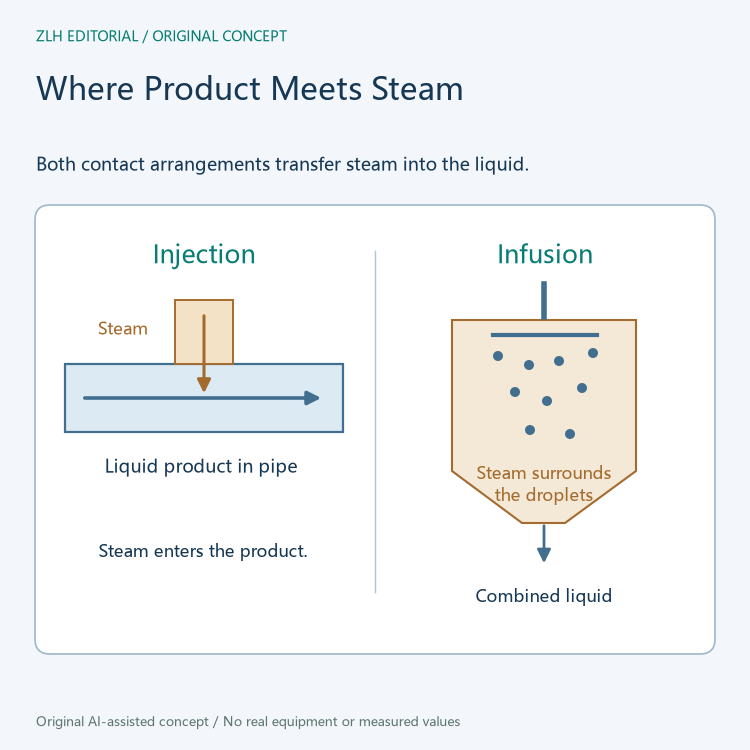
The handbook's injection example sends a preheated product through a steam injector. In this geometry the main product stream follows the pipe, and the steam reaches it through the injector. Condensation occurs where the streams come together. The mixture leaves the contact zone at a higher temperature and includes the condensed water.
A drawing of this arrangement can follow the pipe from the preheater to the injector and then to the holding section. The steam connection ends at the contact zone because it joins the product there. This differs from a heating jacket, whose service fluid has its own return path. The steam line and the combined downstream product line represent different parts of the mass balance.
Infusion sends the liquid into a steam atmosphere
In the handbook's infusion example, the product enters at the top of a vessel and is distributed into small streams and droplets. The drops pass through an atmosphere of steam. Steam condenses at their surfaces as they descend. Product then collects near the bottom of the vessel and leaves as a continuous stream. The handbook relates the evenness of heating to how uniformly that distributor forms droplets.
The most useful difference on a schematic is which flow enters the other. Injection adds steam to a flowing product. Infusion distributes product into a region containing steam. Both depend on direct contact and condensation, but the pipe contact point and the vessel with a falling product path are different ways to expose liquid surfaces to steam.
Vacuum flash cooling carries water out as vapor
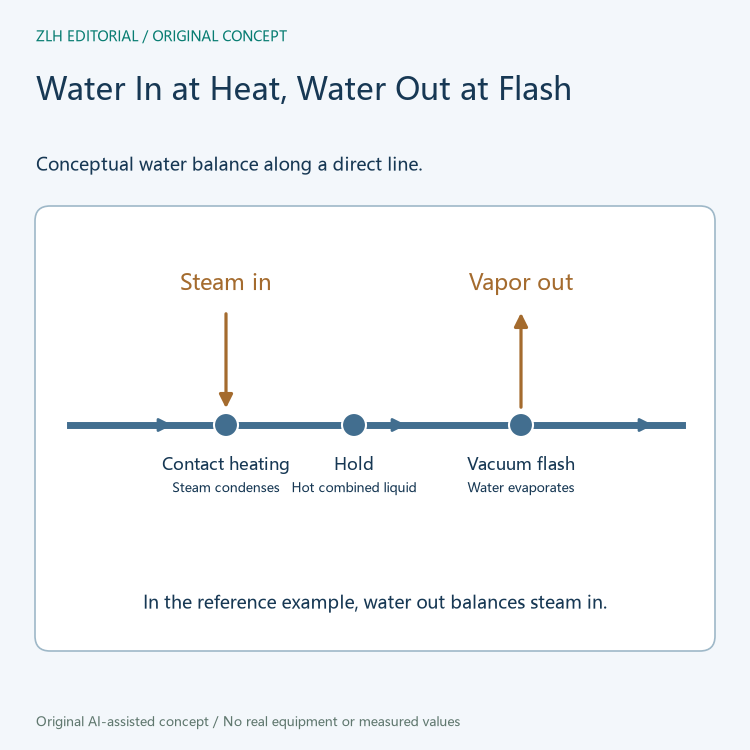
After the direct heating and holding stages, the handbook's example sends the hot liquid to a vessel at lower pressure. Lowering the pressure allows part of the water to evaporate. Vaporization takes energy from the liquid that remains, cooling it rapidly. The example controls the vacuum so that the water leaving as vapor balances the water added by the injected steam.
That balance concerns quantities of water. The individual molecules leaving the vessel can come from the combined liquid. By contrast, an indirect cooler transfers heat through a wall and does not itself remove that added mass from the product. The handbook explicitly discusses a design with direct heating and indirect cooling in which the condensate dilutes the product.
Follow the product and utility lines separately
A useful equipment description can identify where the product first meets steam, where it spends time after heating, and where vapor leaves. For example, a tubular preheater, a direct injector, a holding tube and a flash vessel all act on the same product stream but have different responsibilities. The service stream added at the injector and the vapor stream leaving the vessel are distinct material connections.
The words injection and infusion identify the contact geometry. A complete line description also identifies the heating and cooling stages around it and how the manufacturer defines the water balance. Those details make it possible to read a process diagram without treating each temperature change as the same kind of operation.
Tetra Pak's long-life dairy processing chapter describes both contact arrangements and the vacuum stage. Its heat exchanger chapter explains heat transfer across a partition and through direct contact. See also the food equipment reference and technical article directory.


