

Water Activity in Food: Equilibrium and Moisture Content
2026-11-07
Water Activity in Food: Equilibrium and Moisture Content
Water Activity in Food describes the equilibrium vapor pressure of water associated with a sample relative to pure water at the same temperature. Moisture content answers a different question about how much water the material contains. Both can describe the same specimen, but they refer to different measurements and can move differently as the material or its composition changes.
Water activity compares two vapor pressures
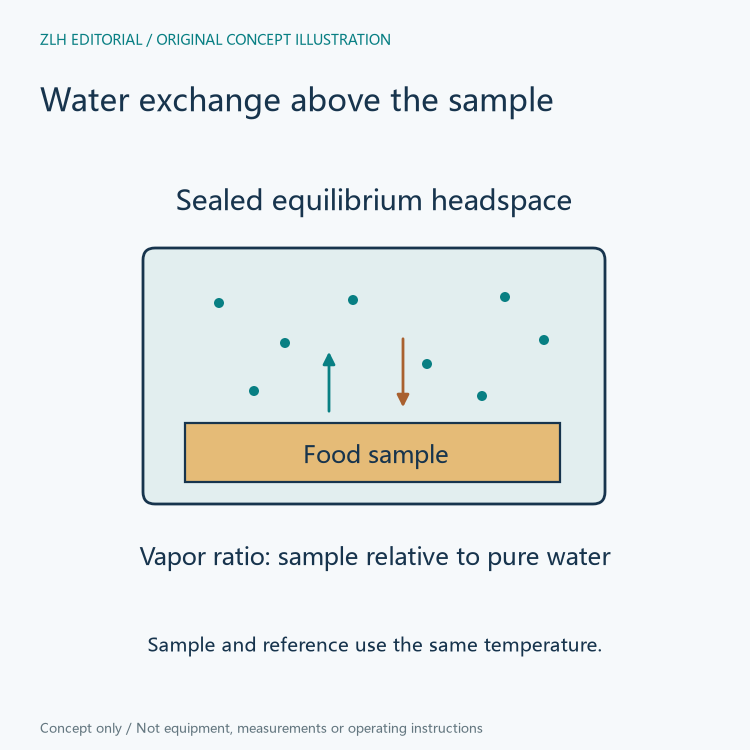
AQUALAB's definition starts with the thermodynamic activity of water relative to a pure-water reference. Under the usual conditions discussed for foods, the definition is expressed through vapor pressure. The numerator is the water vapor pressure associated with the sample at equilibrium. The denominator is the saturation vapor pressure of pure water at the same temperature. Their ratio has no units.
When the water vapor in the enclosed space above the sample reaches equilibrium with it at the stated temperature, that space provides a way to observe the ratio. Equilibrium relative humidity expressed as a percentage equals one hundred times the water activity. For a fictional example, equilibrium relative humidity of 72 percent corresponds to a water activity of 0.72. The percentage in that comparison describes the vapor state above the sample.
Moisture content counts water in the material
Moisture content concerns the amount of water present. A reported percentage can express water mass relative to the total sample mass or use another named basis, such as dry mass. Two values with the same percentage sign can therefore describe entirely different ratios. In a fictional record, 10 grams of water in a 100 gram sample is 10 percent moisture on a total-mass basis. That arithmetic supplies no equilibrium vapor pressure.
The amount of water can matter for mass balance, while water activity describes its thermodynamic relation to surrounding vapor. As AQUALAB explains, dissolved species, interactions with a solid matrix, and capillary effects can influence that relation. Different materials can therefore contain the same amount of water and have different water activities. Two materials can also show the same activity while holding different quantities. At a common temperature, equal water activities imply the same equilibrium vapor pressure. If two materials communicate through the same headspace, that equality removes the water activity difference driving net moisture transfer between them. Their moisture contents can still differ because each matrix holds water according to its own relationship.
The equilibrium condition belongs to the reading
A headspace reading reflects the sample's water activity when the vapor and sample share the intended equilibrium condition. Earlier in the exchange, the vapor in the chamber can still be changing. The relation between the measured headspace and the sample then depends on when the reading was taken. Room humidity is a separate observation from the equilibrium humidity of the air enclosed with the sample.
Temperature also belongs with the value. It determines the pure-water reference pressure and can change how a particular material interacts with water. The AQUALAB definition explains that the direction of a material's change with temperature is product-specific. For comparisons across records, a water activity value with a stated temperature is more informative than an unlabeled decimal.
A sorption isotherm links the quantities at one temperature
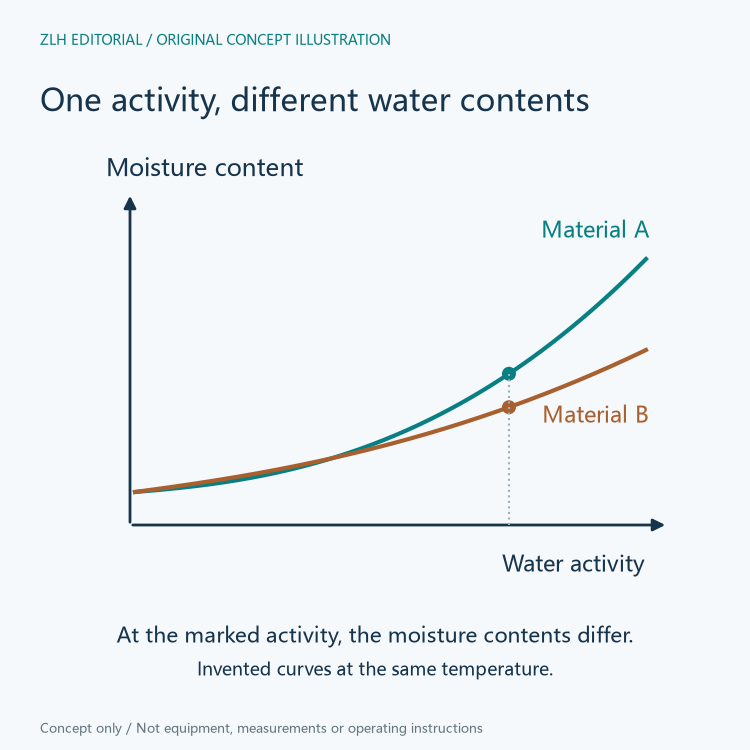
The AQUALAB comparison describes a moisture sorption isotherm as a curve relating water activity and moisture content at fixed temperature. A plotted point pairs a moisture amount with an equilibrium vapor relationship for a particular material. The curve can be nonlinear, and materials with different compositions can follow different curves. One measured pair does not determine the relationship at all other water contents.
The second figure uses two invented curves to illustrate that distinction. At the same activity, the two hypothetical materials lie at different moisture contents. Reading across from a common content could also identify different activities. A comparison based on a specific isotherm needs to keep the material and the temperature with the curve. Where adsorption and desorption are reported separately, the moisture history also belongs with the observation.
Keep the two quantities distinct in a sample report
A record can place moisture content and water activity side by side, with the moisture basis and the activity measurement temperature stated. This preserves what each result measures. If the question concerns water in a mass balance, the content supplies an amount. If the question concerns the equilibrium with surrounding vapor, the activity supplies a ratio. An isotherm provides the material-specific connection when both quantities are needed together.
Related material appears in the food equipment and measurement section and technical article directory. Sources are AQUALAB's water activity definition and comparison of moisture content and water activity.


