

Ingredient Feeder Signals: Volume Rate and Weight Loss
2026-11-06
Ingredient Feeder Signals: Volume Rate and Weight Loss
Ingredient Feeder Signals describe more than the rotation of a screw beneath a hopper. Qlar distinguishes volumetric feeding from feeding controlled through measured weight loss. The difference matters in ingredient-handling equipment because a given volume of bulk material need not represent the same mass under every packing condition. A useful equipment description preserves what the controller actually observes.
Volumetric feeding supplies a volume per unit time
Qlar's volumetric-feeder glossary describes supplying a certain volume of material per unit time. Feeding is changed by adapting auger speed. The entry also discusses relating known material volume to mass-based discharge through calibration.
The documented distinction is that volumetric feeding does not determine mass by weighing. A speed-to-delivery relationship therefore has a material context. A motor-speed field is not itself a direct observation of the mass leaving the hopper, even when an equipment appendix expresses a calibrated delivery estimate in mass units.
Bulk density connects volume with contained material mass
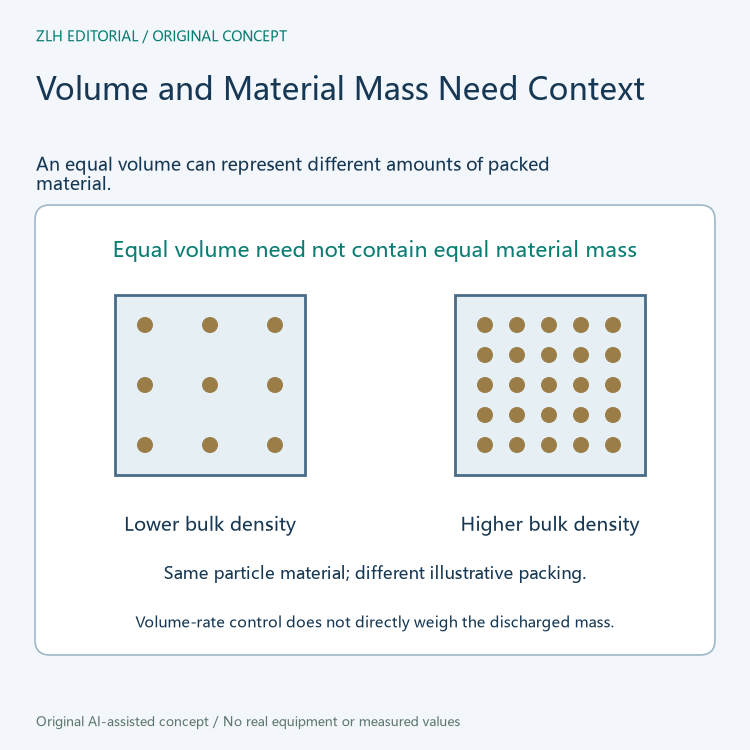
Qlar explicitly says that volumetric feeders cannot detect fluctuations in material density. Its loss-in-weight entry also identifies changes in auger filling and bulk density as sources of feed-rate variation. Those observations explain why the physical material state belongs beside a volumetric feeder description.
The original packing illustration uses equal-sized regions containing different amounts of the same imagined particles. It is an analogy for bulk density, without measured ingredient properties. Equal container volume alone does not establish equal material mass when the packing represented inside that volume changes.
Loss-in-weight measurement observes the weighed assembly
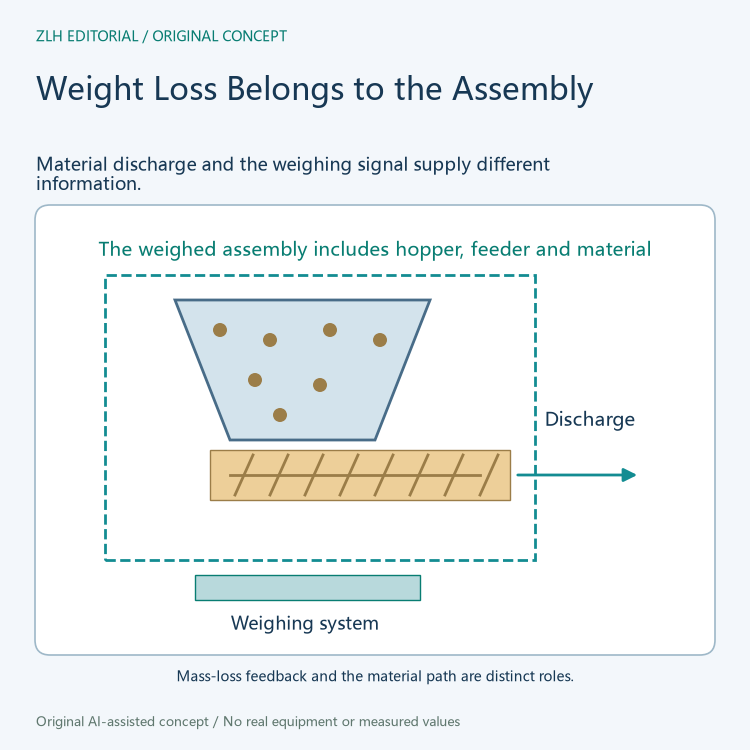
Qlar's loss-in-weight description says that the feeder, hopper and contained material are continuously weighed. As material leaves through the feeding device, the system weight decreases. The useful information is the rate of that loss, rather than only the weight at one instant.
An instantaneous weight describes the assembly at one moment. Comparing weight over time describes how quickly that quantity changes. These are distinct information objects even when they come from the same weighing system.
The weighed assembly consequently differs from an isolated ingredient sample placed on an unrelated bench scale. Its boundary includes the documented equipment and contents. The first original equipment diagram marks the hopper and feeding device as an assembly associated with the weighing system, while the material discharge follows its separate path.
The control relationship follows weight loss over time
The manufacturer explains that loss-in-weight control changes feed rate so that the speed of weight loss matches the desired feeding rate. It describes compensating for auger filling and bulk-density variation by adapting auger speed. Measurement and mechanical discharge therefore participate in a feedback relationship.
A screw feeder can appear in both volumetric and loss-in-weight equipment. The presence of a screw alone does not identify the measurement principle. The important addition in the loss-in-weight account is the weighing-and-control relationship, not a rule that every such feeder must use a completely different-looking discharge screw.
Mechanical feeding and weighing retain separate roles
Qlar lists controlled feeding devices such as augers, chutes and pumps alongside scales or load cells and a controller. This makes the loss-in-weight description broader than a single screw geometry. The discharge member moves material, while the weighing system supplies information used by control.
The same entry describes optional agitators as part of some material-handling arrangements. An agitator and the weighed hopper should consequently retain their own identities in an equipment record. A mixing or flow-assistance member is not automatically the element that measures the rate of material leaving.
A food-industry example still needs its particular configuration
Qlar's ProFlex F page provides a concrete food-industry example supporting both gravimetric and volumetric continuous feeding. It describes different hopper, auger and spiral choices for material characteristics and delivery requirements. The common application does not collapse the two measurement principles into one.
The page also distinguishes weighed and stationary parts in its discussion of the weighing module. That boundary belongs to the equipment's measuring arrangement. A record that only lists an overall enclosure or hopper photograph may omit the relationship connecting material discharge to the weight signal.
Name the signal before interpreting the rate
An ingredient-handling reference can identify the feeding principle, the discharge device, the weighed boundary where applicable and the stated material context. It can then retain whether a delivery value comes from a volumetric relationship or from weight-loss feedback.
Related explanations appear in the ingredient equipment technology collection and equipment article directory. The original diagrams explain assembly and material roles without real ingredient measurements, motor commands, food-quality claims or feeding recipes.
Sources: Qlar loss-in-weight feeders; Qlar volumetric feeder; Qlar ProFlex F.


