

Kitchen Robot Sensor Notes: The Thermocouple Reference
2026-11-06
Kitchen Robot Sensor Notes: The Thermocouple Reference
The Thermocouple Reference is part of the measurement, even when the point of interest lies at the other end of a probe. A kitchen robot's equipment appendix may list a thermocouple and a temperature input, but the sensor voltage does not represent one junction's temperature independently of its reference conditions. The relationship explains why cold-junction compensation belongs in a technical description of the input system.
Read the measuring and reference temperatures together
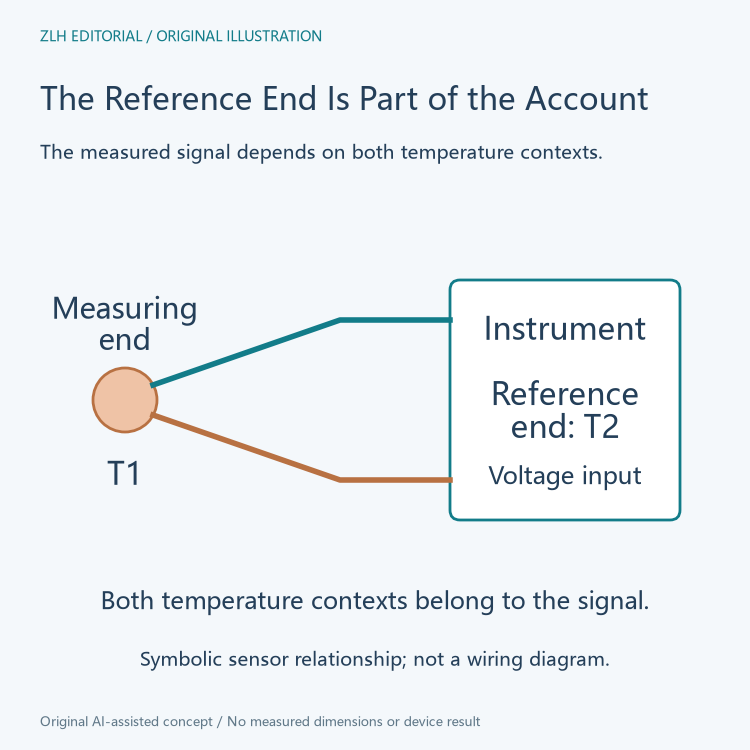
Fluke's official thermocouple fundamentals describes two dissimilar thermoelement wires joined at the measuring end and connected to the instrument through a reference end. A temperature difference along this arrangement is associated with a thermoelectric voltage. The measuring junction and the reference junction therefore have different roles within one measurement account.
The word cold identifies the reference role; it should not be read as a claim that this part of an installed instrument is necessarily ice cold. A diagram can label the measuring and reference temperatures without assigning either a numerical value. That preserves their relationship without inventing a probe reading or an equipment operating condition.
Understand the zero-degree reference behind a table
OMEGA's official temperature measurement guidelines explains that commonly used thermocouple tables assume a reference temperature of zero degrees Celsius. An instrument whose actual reference end is at another temperature needs to account for that difference. The table's reference basis and the physical terminal's temperature are related but distinct pieces of information.
Consequently, the presence of a table or a thermocouple type in an appendix does not establish the actual reference temperature. The input system's compensation account explains how that physical context is handled. Keeping the reference basis visible is more useful than treating every voltage-to-temperature conversion as if it began with an actual ice-point reference.
Cold-junction compensation belongs to the conversion account
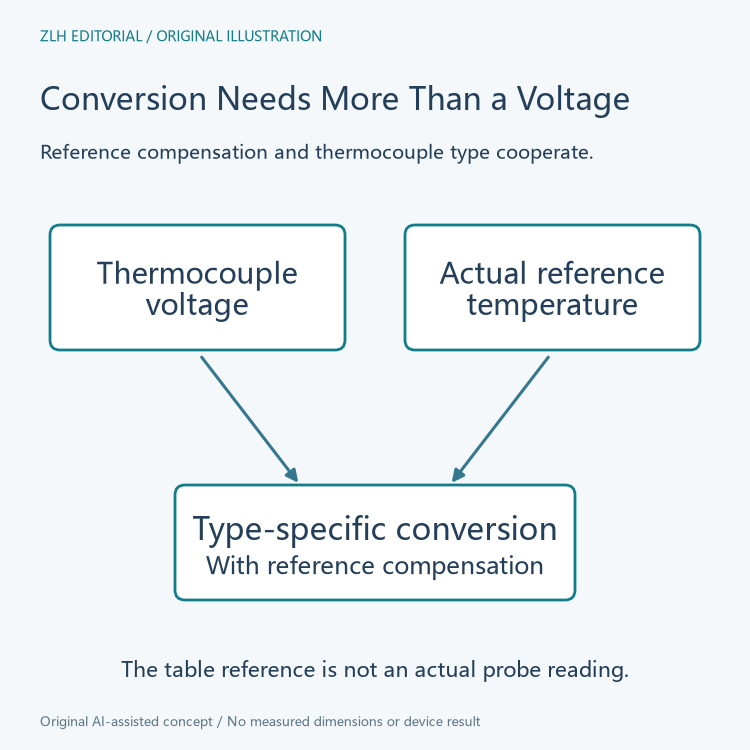
The OMEGA explanation describes electronic correction for the difference between the actual reference temperature and the table's zero-degree reference. Fluke likewise describes cold-junction compensation in the measuring instrument. This correction is part of interpreting the thermocouple signal, rather than an extra temperature that should be mistaken for a second measurement of the food or process.
A technical information sheet can therefore identify the thermocouple type, the measuring input and the reference-temperature provision separately. An input with internal compensation and an arrangement using an external reference have different supporting descriptions. The reference provision can be located at the instrument connection rather than at the measuring tip. The exact device documentation determines which applies; a generic sensor name does not fill in that system detail.
The type-specific relationship is not a straight-line identity
Fluke explains that thermocouple types use different material combinations and have their own voltage-temperature relationships. It also states that the relationship is not linear. A converted reading consequently needs the appropriate type relationship as well as the reference account. A voltage value alone is not a complete temperature specification.
For a robot equipment record, this means retaining a type identifier instead of shortening every input to temperature sensor. The identifier belongs beside the instrument's supported-input information. This is a description of the measurement chain, not a recommendation to change a sensor type or apply a numerical conversion assembled from unrelated devices.
Keep compensation distinct from wire condition
Fluke makes another important distinction: thermoelectric voltage is generated along wire exposed to a temperature gradient, rather than exclusively at the small joined point. Its explanation depends on homogeneous thermoelement material. Heat exposure, chemical effects or mechanical damage can change that condition and affect the relationship between voltage and temperature.
Cold-junction compensation addresses the reference-temperature contribution. Its presence does not by itself establish that the thermocouple wire retains the required material condition or that the whole system has been calibrated. A maintenance appendix can retain separate entries for compensation capability, sensor identity and supplied calibration information, allowing each to answer its own question.
Describe a sensor chain before interpreting its application
The two primary pages were read on November 6, 2026, including their reference-junction, material and conversion qualifications. The OMEGA page is a general technical guideline, while the Fluke article explains thermocouple fundamentals and calibration context. Their sensor principles do not establish the suitability of a particular robot installation or a food-processing temperature limit.
The original diagrams distinguish the measurement path from the reference contribution and show the information needed to interpret a converted reading. They contain no actual probe voltage, temperature record or food-process result. Related material appears in the kitchen robot equipment collection and article directory. Keeping the reference temperature beside the thermocouple type makes a sensor description technically complete enough to understand its basic conversion responsibilities.


